


Nine Casino and the UK Market — An Analyst's Perspective
Nine years in iGaming regulation analysis teaches you one thing fast: the gap between what a casino says about itself and what the data shows is almost always wider than players expect. Nine Casino is a textbook case. Ask around forums, search for reviews, and you will find a bizarre landscape — a site about hiking gear rating it 9/10, an IELTS prep platform claiming it holds a UKGC licence (it does not), and a flow cytometry equipment supplier calling the experience "a rollercoaster of emotions." I wish I were making this up.
The UK gambling industry generated £4.5 billion in gross gambling yield for October-December 2025 alone per UKGC quarterly data — with remote casino contributing £1.49 billion of that — and the Gambling Commission's most recent full-year industry report (financial year April 2023 to March 2024, published July 2025) put total annual GGY at a record £15.6 billion. The stakes — pun intended — have never been higher for players trying to separate legitimate analysis from affiliate noise. Nine Casino operates in the middle of this landscape, holding a Curaçao licence while serving an audience that increasingly includes British players. That audience is navigating a market reshaped by new stake limits, a near-doubling of Remote Gaming Duty, and the fastest growth in offshore gambling the UK has ever recorded.
This review does not recycle the same bonus table you have already seen ten times. I have spent weeks cross-referencing Nine Casino's actual terms against UKGC operator data, Curaçao Gaming Authority records, GamStop self-exclusion statistics, and H2 Gambling Capital forecasts. Every claim in this piece either cites a verifiable source or is flagged as my professional assessment. That is the standard this niche desperately needs — and the standard I intend to hold.
What follows is a section-by-section breakdown covering licence legitimacy, bonus maths, game catalogue depth, payment mechanics, UK regulatory context, safety considerations, and a final verdict built on evidence rather than marketing copy. If you are a UK player weighing up Nine Casino, this is the analysis your decision deserves.
The Hard Numbers Behind This Review
- Nine Casino holds a Curaçao licence, not UKGC — meaning no GamStop integration, no UK dispute resolution, and no Gambling Commission oversight for British players.
- The UK offshore gambling sector has tripled to £16.6 billion in stakes since 2019, with projections reaching £33 billion by 2028. Nine Casino operates within this expanding unregulated space.
- Remote Gaming Duty rose from 21% to 40% in April 2026, widening the cost gap between licensed and offshore operators — and potentially accelerating player migration to platforms like Nine Casino.
- GamStop self-exclusion registrations hit 562,000 by the end of 2025, with a 40% spike in youth sign-ups. Nine Casino is not connected to this protection scheme.
- Verify the operator's CGA green seal status directly, set personal limits independently, and understand that every protection available at UKGC-licensed sites must be self-managed at offshore platforms.
Licence Status: Curaçao, Not UKGC
A colleague once told me that the quickest way to assess a casino review is to search the page for "UKGC." If the review does not mention whether the operator holds a UK Gambling Commission licence — or worse, claims it does when it does not — close the tab. Nine Casino does not hold a UKGC licence. It operates under a Curaçao licence, and that single fact shapes every other aspect of the experience for British players.
The difference is not cosmetic. UKGC-licensed operators must comply with strict conditions on fund segregation, advertising standards, affordability checks, and dispute resolution through approved Alternative Dispute Resolution providers. They pay Remote Gaming Duty to the UK Treasury. They participate in GamStop, the national self-exclusion scheme. And they are subject to enforcement actions — in the 2025-26 period alone, the Gambling Commission issued 741 cease-and-desist orders, sent nearly 400,000 URLs to search engines for removal, and blocked 1,134 sites. Awareness of UKGC deposit limits rose by 8% last year, and trust in licensed operators reached 71%, largely because visible UKGC branding gives players a verifiable quality signal.
| Criteria | UKGC Licence | Curaçao (CGA) Licence |
|---|---|---|
| Player fund segregation | Required by licence condition | Required under LOK, enforcement developing |
| Dispute resolution | Approved ADR providers mandatory | CGA complaints process, limited track record |
| Self-exclusion integration | GamStop participation mandatory | Not connected to GamStop |
| Advertising standards | ASA and UKGC codes enforced | Minimal advertising regulation |
| Affordability checks | Enhanced due diligence required | Basic KYC only |
| Tax contribution to UK | Remote Gaming Duty (40% from April 2026) | No UK tax obligation |
Curaçao-licensed operators sit outside UK jurisdiction entirely. The Gambling Commission has no power to investigate complaints against them, freeze their accounts, or compel payouts. When I review an operator like Nine Casino, I am not saying this to alarm anyone — I am saying it because every other review I found in the top ten search results either glossed over this point or, in one memorable case, fabricated a UKGC licence claim from thin air.
Regulatory reality check: Nine Casino's Curaçao licence means UK players have no access to UKGC complaint procedures, no guaranteed fund protection under UK rules, and no participation in the GamStop self-exclusion network. These are not theoretical differences — they define what happens when something goes wrong.

For a deeper examination of what the Curaçao licence specifically provides and how the new regulatory framework compares to UKGC standards, I have written a dedicated analysis covering the Curaçao licence and its implications for UK player rights.
What the 2024 LOK Reform Changed for Players
If you looked at Curaçao gaming licences before December 2024, you were looking at a completely different system. The old framework relied on master licence holders — companies like Antillephone and Curaçao Interactive Licensing — who then issued sub-licences to individual operators. Oversight was minimal, enforcement was effectively non-existent, and the phrase "Curaçao-licensed" became shorthand in the industry for "barely regulated."
That changed when the Nationale Verordening op de Kansspelen — the LOK, or National Ordinance on Games of Chance — came into force in December 2024. The LOK replaced the entire master-licence system with a single regulator: the Curaçao Gaming Authority (CGA). All existing sub-licences expired in January 2025, and operators had to apply directly to the CGA for new approval.
The CGA introduced a colour-coded seal system during the transition. Operators received orange seals as temporary authorisation while their applications were processed. Those orange seals expired on 15 October 2025. After that date, only operators holding a green CGA seal were legally permitted to operate. Any Curaçao-licensed casino still displaying an old master-licence number or an expired orange seal is operating without valid authorisation.
For Nine Casino specifically, the question UK players should ask is straightforward: does the operator hold a current green seal from the CGA? The answer determines whether even Curaçao's own regulatory framework — limited as it is compared to the UKGC — actually applies. I recommend verifying directly through the CGA's public register rather than trusting the operator's own claims, because the transition caught dozens of operators off guard, and not all of them updated their site footers honestly.
The LOK reform is a step forward for Curaçao. It introduces requirements for player fund segregation, responsible gambling tools, and a formal complaints mechanism. Whether those requirements will be enforced with the rigour of a mature regulator remains an open question — the CGA is less than two years old, and its track record is still being written.
Welcome Bonus and Promotions Breakdown
I have a rule when reviewing casino bonuses: ignore the headline number and read the terms first. Every operator in this niche leads with the biggest possible figure — "450% match! 250 free spins!" — because it works. Players click. But the headline number is the least important detail in any bonus offer. What matters is the wagering requirement, the game weighting, the maximum bet while wagering, and the expiry window. Those four variables determine whether a bonus has genuine value or is essentially unredeemable marketing.
Nine Casino structures its welcome package as a multi-tier deposit match spread across the first several deposits. The exact percentages and spin counts vary depending on when you check — I found at least three different versions across affiliate sites, with figures ranging from "150% + 250 free spins" to "200% match up to £500 + 150 free spins." This inconsistency is itself a red flag. UKGC-licensed operators are required to present bonus terms clearly and consistently; offshore operators have no such obligation, and Nine Casino's promotional material reflects that gap.
Minimum deposit
£30 (reported across multiple sources)
Minimum withdrawal
£20
Welcome bonus structure
Multi-tier deposit match across first deposits
Wagering requirement
Varies by promotion — always check current T&Cs
Free spins
Included in welcome package, restricted to selected slots
Ongoing promotions
Cashback, reload bonuses, VIP programme
The £30 minimum deposit is higher than the industry average for UK-facing operators. Most UKGC-licensed casinos set their minimum at £10, sometimes £5. A higher entry point does not inherently signal a problem, but it means the casino is filtering for players willing to commit more upfront — which is worth noting when you combine it with the bonus terms.
Beyond the welcome package, Nine Casino runs recurring promotions including cashback offers, reload bonuses, and a tiered VIP programme. I cover the full bonus structure, wagering maths, and hidden conditions in a separate breakdown, because the numbers deserve more space than a pillar review can give them.
Understanding the bonus terms matters, but understanding what you are actually wagering on matters more. Let me walk through what Nine Casino puts on the virtual shelves.
Wagering Requirements in Context
Here is where most casino reviews lose me. They list the wagering multiplier — say, 35x — without explaining what that number actually costs you in expected terms. So let me do the maths properly.
A 35x wagering requirement on a £100 bonus means you need to place £3,500 in total wagers before any bonus winnings become withdrawable. If you are playing slots with an average RTP of 96%, your expected loss per £100 wagered is £4. Across £3,500 in wagers, your expected loss is £140. You deposited £100 to unlock a £100 bonus, and the wagering requirement is expected to cost you £140. The bonus is mathematically underwater before you start.
Slot gross gambling yield per minute in the UK sits at approximately £0.24, according to Gambling Commission data from early 2025. At that rate, clearing a 35x wager on a £100 bonus through average-stakes slot play would take roughly 240 hours of spinning — the equivalent of six full working weeks.
This does not mean every player will lose money on the bonus. Variance — the mathematical reality that individual results deviate from expected value — means some players will clear wagering with profit, while most will not. The critical question is whether you understand that the house edge, compounded across thousands of required wagers, tilts the expected outcome against you. Offshore operators are under no obligation to present wagering requirements in these terms. I think they should be, but the regulatory framework they operate under does not demand it.
Watch out for additional conditions that further erode bonus value: maximum bet limits while wagering (often £5 or lower), game weighting that counts table games at 10-20% versus slots at 100%, and expiry windows that void uncompleted wagering after 7-30 days. These details are buried in terms and conditions pages that I have found, in Nine Casino's case, to be less accessible than those at UKGC-licensed competitors.
Games and Software Providers
When I first opened Nine Casino's game lobby, I counted providers before I counted titles. Provider diversity tells you more about a casino's market position than raw game numbers, because reputable studios — Pragmatic Play, Evolution, BGaming, Microgaming, Booming Games — conduct their own due diligence before partnering with an operator. A casino running exclusively no-name providers is a different proposition from one hosting Tier-1 studios whose own licensing depends on the companies they supply.
Nine Casino hosts games from a substantial roster of providers. The slot library spans several thousand titles, which places it in the upper range for Curaçao-licensed operators. Gambling Commission data for the January-to-March 2026 quarter shows UK slot gross gambling yield reached £773 million, a 12% year-on-year increase despite the £5 stake cap being in effect since April 2025. Slots remain the dominant product by revenue, and Nine Casino has built its catalogue accordingly.
The live dealer section features tables from Evolution and other live-streaming providers, covering roulette, blackjack, baccarat, and game show formats. Live casino is the fastest-growing segment in online gambling, and Nine Casino's offering here is comparable to mid-tier UKGC-licensed operators — a genuine strength for a Curaçao-licensed platform.
I examine the complete game catalogue, provider-by-provider, in my guide to Nine Casino's slots, live tables, and game providers. What follows here is the structural overview that matters most for a regulatory analyst: slot categorisation and the RTP question.
Slots
Megaways, classic, video, bonus buy, jackpot — multi-provider library spanning several thousand titles across all major mechanics.
Live dealer
Roulette, blackjack, baccarat, game shows — streamed from professional studios with multiple table limits.
Table games
RNG-powered versions of classic games for players who prefer software-based play without live dealers.

Slot Categories and RTP Ranges
Nine Casino organises its slots into subcategories that will be familiar to experienced players: Megaways titles with variable reel mechanics, bonus buy slots where you can purchase direct access to the feature round, progressive jackpots feeding into shared prize pools, and classic three-reel formats for those who prefer simplicity. This categorisation mirrors what you would find at most large-scale online casinos, UKGC-licensed or otherwise.
The RTP question is more nuanced than most reviews admit. RTP — return to player — is a theoretical percentage calculated over millions of spins. An RTP of 96% means that, over an infinite time horizon, the game returns £96 for every £100 wagered. Some affiliate sites have claimed Nine Casino hosts slots with RTPs reaching 99.30%. I treat that figure with scepticism. While certain video poker variants and specific slot configurations can push theoretical RTP above 99%, this is not representative of the broader catalogue. Most mainstream video slots sit between 94% and 97%.
The critical point for UK players: since April 2025, UKGC-licensed operators must apply a £5 maximum stake per spin on online slots for players aged 25 and over, dropping to £2 for those aged 18-24. Nine Casino, operating outside UKGC jurisdiction, is not bound by these limits. Whether that is a feature or a risk depends entirely on your perspective — and your self-discipline. I discuss the regulatory mechanics of this limit in a later section, because it is reshaping how British players interact with slot games across the entire market.
Deposits, Withdrawals and Processing Times
Fast withdrawal has overtaken bonus size as a top factor UK players use to choose a casino. UKGC data shows 96.3% of withdrawals at licensed operators in 2024 were processed instantly, with only 0.1% taking longer than 48 hours. That sets an expectation offshore operators struggle to match — players are tired of waiting five to seven business days for their money, and operators who cannot match the speed of e-wallet and crypto transfers are losing ground to those who can.
Nine Casino accepts deposits and withdrawals through a mix of traditional and digital methods. Bank cards, e-wallets, and cryptocurrency all feature in the payment lineup. The minimum deposit sits at £30, which — as I noted in the bonus section — is notably higher than the £5-£10 standard at most UKGC-licensed operators. The minimum withdrawal is £20.
Processing times vary by method, and this is where the experience diverges from what UKGC-licensed platforms offer. At a licensed UK casino, the operator must process withdrawal requests without unnecessary delay — a condition enforced by the Gambling Commission. Offshore operators set their own internal processing windows, which typically include a "pending period" of 24-72 hours before the withdrawal even enters the payment queue. Add the payment provider's own processing time on top of that, and a withdrawal that takes 4 hours at a UKGC site might take 3-5 days at Nine Casino.
| Payment method type | Typical deposit speed | Typical withdrawal speed |
|---|---|---|
| Bank card | Instant | 3-7 business days |
| E-wallet | Instant | 24-48 hours after pending period |
| Cryptocurrency | Network confirmation time | Potentially faster, varies by coin |
| Bank transfer | 1-3 business days | 3-7 business days |
KYC verification — the process of submitting identity documents before your first withdrawal — adds another variable. Offshore casinos are often less transparent about what triggers enhanced verification and how long the review takes. I have seen reports from Nine Casino players describing verification windows ranging from a few hours to several days, with minimal communication during the process. For a comprehensive breakdown of methods, limits, fees, and what actually causes delays, see my dedicated guide to the Nine Casino withdrawal process.
Cryptocurrency Options at Nine Casino
Cryptocurrency is the most polarising topic in UK gambling right now. Nine Casino accepts BTC, ETH, USDT, and other tokens — a feature that draws a specific segment of players who value transaction speed and a degree of pseudonymity that traditional payment methods cannot offer.
The UK context makes this particularly interesting. Approximately 24% of UK adults now hold cryptocurrency, according to Gemini's 2025 global report. That is a massive potential audience for crypto-enabled casinos, and it partly explains why the UKGC has begun exploring the possibility of allowing licensed operators to accept crypto payments. Tim Miller, Executive Director at the Gambling Commission, stated at the Betting and Gaming Council's annual meeting in February 2026 that the regulator wants to "start looking at what the potential path forward would be to create a way for cryptoassets to be used as a consumer payment option for licensed and regulated gambling" in the UK.
The Financial Conduct Authority plans to assume regulatory authority over crypto assets from 25 October 2027. Until then — and until the UKGC formally permits crypto — cryptocurrency gambling in the UK occupies a grey zone. It is not illegal for UK players to use crypto at offshore casinos, but there are no UK-specific protections governing those transactions.
For Nine Casino players using crypto, the practical advantages are potentially faster withdrawals and lower fees. The practical risks are price volatility between deposit and withdrawal, limited recourse if a transaction is disputed, and the absence of chargeback protections that bank cards provide. Some offshore operators also apply reduced or no KYC requirements for crypto users — a feature that cuts both ways, speeding up access while removing a layer of fraud protection.
UK Regulatory Landscape and What It Means for Offshore Players
When the Gambling Commission's industry statistics for fiscal year April 2023 to March 2024 landed in July 2025, the headline figure was £15.6 billion — a record gross gambling yield across the UK industry. Andrew Rhodes, then UKGC CEO until his April 2026 departure, had been warning for months that the pace of change was accelerating beyond expectations. Rhodes described crypto gambling as a challenge that had moved from a "five-year-away problem" to an "18-months-to-two-years challenge."
For UK players considering Nine Casino, the regulatory landscape is not background noise — it is the single most important context for understanding what you are choosing and what you are giving up. The UK has the most heavily regulated online gambling market in Europe, and the gap between playing inside that framework and playing outside it widened dramatically in the first half of 2026.
The headline regulatory shift is fiscal. From 1 April 2026, Remote Gaming Duty — the tax UKGC-licensed operators pay on their UK revenue — nearly doubled, rising from 21% to 40%. The government projects this increase will generate an additional £810 million in 2026-27, growing to £1.16 billion annually by 2030-31. Approximately 310 companies are directly affected: 160 in remote betting, 95 in remote gaming, and 55 operating across both.
That tax increase matters for players at offshore casinos because it reshapes the competitive landscape. UKGC-licensed operators, now carrying a 40% tax burden, face pressure to tighten bonus terms, reduce promotional spending, or adjust game offerings to maintain margins. Meanwhile, offshore operators like Nine Casino pay no UK tax, giving them a structural cost advantage that translates into more generous-looking bonuses and fewer operational constraints. Baroness Twycross, the UK Minister for Gambling, acknowledged the challenge directly in February 2026: "We know the real harm that unregulated gambling can cause, exploiting vulnerable people and leaving consumers without the protections they deserve."
The black market data reinforces the concern. Stakes placed with unlicensed operators in the UK grew from £5 billion in 2019 to £16.6 billion in 2025 — more than tripling in six years and doubling in just the last two. The legal market's share dropped from 97% to 92% over the same period. Forecasts from H2 Gambling Capital project offshore stakes reaching £33 billion by 2028, representing nearly one-fifth of all online wagers placed by UK residents.
The regulatory paradox: Stricter regulation and higher taxes on licensed operators are designed to protect players. But if the cost differential drives more players toward unregulated platforms, the net effect on player protection may be negative. This is the central tension shaping UK gambling policy right now, and Nine Casino sits squarely on one side of that divide.
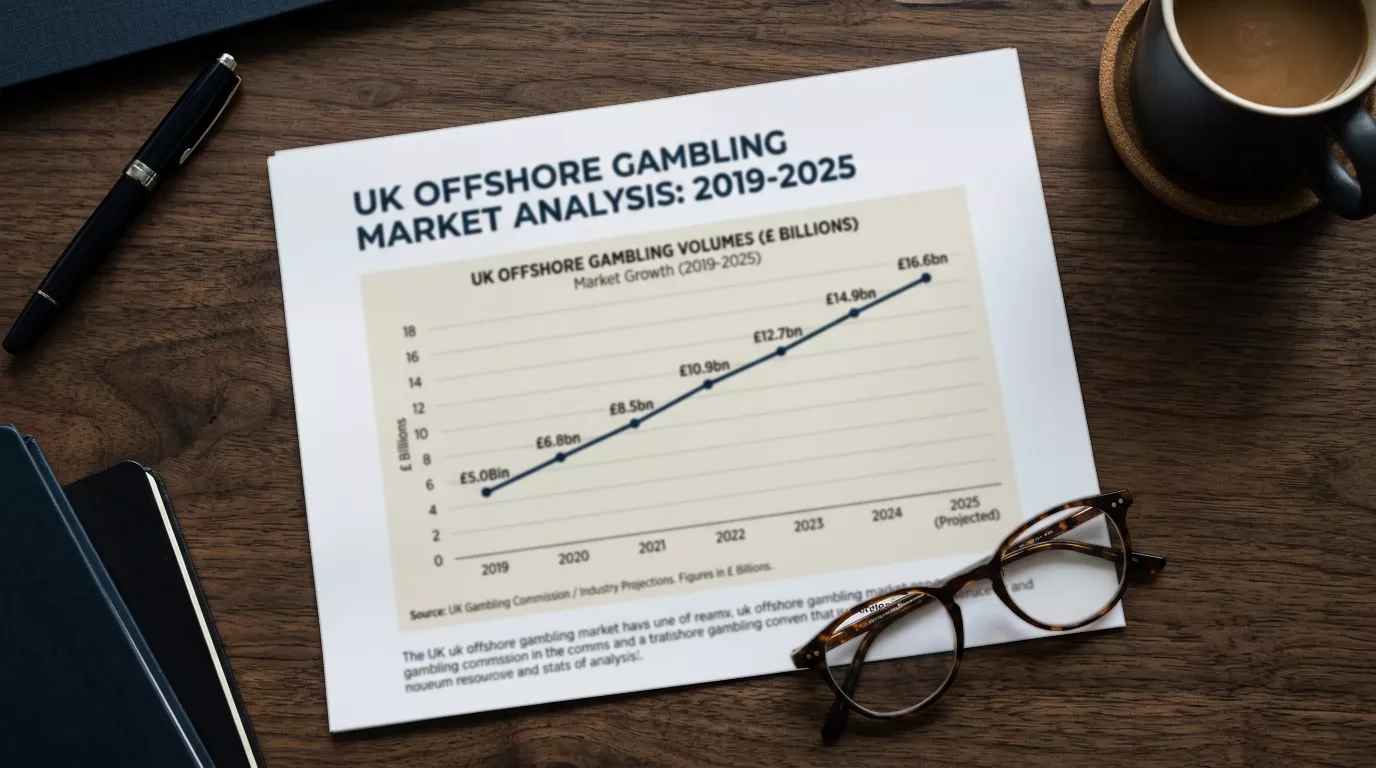
The government has responded by allocating an additional £26 million to the Gambling Commission over three years specifically for combating the illegal market. Whether that funding is sufficient to counter a £16.6 billion offshore sector remains to be seen.
The £5 Stake Limit and Its Ripple Effects
On 9 April 2025, the UK became one of the first major markets to impose a mandatory stake limit on online slots: £5 per spin for players aged 25 and over, tightening to £2 per spin for those aged 18-24 from 21 May 2025. The two-tier structure was designed to offer additional protection to younger players, who GamStop data shows are registering for self-exclusion at sharply increasing rates.
Despite widespread industry predictions that stake limits would crater slot revenue, the actual data told a different story. UKGC slot GGY reached £773 million for the January-to-March 2026 quarter — a 12% year-on-year increase. Slots active accounts rose 6% year-on-year to 4.8 million. Players adapted by spinning more frequently at lower stakes rather than reducing their overall play.
Nine Casino, operating outside UKGC jurisdiction, is not required to enforce these limits. A British player at Nine Casino can still place £50, £100, or higher stakes on a single slot spin — something that is no longer possible at any UKGC-licensed operator. For some players, that is the entire appeal. For others, it represents exactly the kind of uncontrolled environment the stake limit was designed to prevent.
The behavioural data is instructive. Sessions lasting more than one hour on slot games increased by 15% after the limits were introduced at licensed sites. Players did not stop playing — they played longer at lower individual stakes, resulting in comparable or higher total wagers across extended sessions. Whether the same pattern would hold at an offshore casino without stake limits is an open question, but it suggests that the relationship between stake caps and player protection is more complex than the headline regulation implies.
I analyse the legal scope, enforcement gaps, and player behavioural shifts around the stake limit in more detail in a dedicated piece. For this review, the takeaway is that Nine Casino's freedom from UK stake limits is a structural feature of its offshore status — not a deliberate player benefit — and it comes packaged with every other consequence of operating without UKGC oversight.
Safety, Fairness and Player Protection
Every casino review in the top ten for this search term mentions "SSL encryption" as if it were a differentiator. It is not. SSL is a baseline technology that even phishing sites implement. Real safety analysis starts with questions that SSL cannot answer: Are player funds held in segregated accounts? What happens to deposits if the operator becomes insolvent? Is there an independent audit trail for game outcomes? And — most critically for UK players — what recourse do you have when something goes wrong?
At Nine Casino, the answers to these questions are less reassuring than at UKGC-licensed alternatives. The Curaçao Gaming Authority's new LOK framework does require some level of fund protection, but the enforcement mechanisms are nascent. The CGA has not yet been tested by a major operator insolvency, and its public record of regulatory actions is thin compared to the UKGC's decades of published enforcement data.
The scale of the issue is not trivial. Channelisation in the UK has fallen from 97% in 2019 to 92% in 2025 per H2 Gambling Capital data, with £16.6 billion staked at offshore operators in 2025 alone — implying millions of UK adults whose deposits, winnings and personal data sit beyond the reach of the UK's regulatory framework. The UKGC's Gambling Survey for Great Britain reports problem gambling at 2.7% of adults and at-risk gambling at 3.1% under PGSI methodology; clinical-threshold problem gambling per the 2025 Adult Psychiatric Morbidity Survey sits lower at around 0.3%. Zoe Osmond, CEO of GambleAware, put it plainly in early 2025: "No form of gambling is completely without risk. However, this new research shows that there are some particular types of gambling which can lead to an increased chance of experiencing gambling harm."
Do
- Verify the operator's licence status directly through the CGA register before depositing
- Set personal deposit and loss limits before you start playing, using external tools if the platform's own options are limited
- Keep records of all deposits, withdrawals, and correspondence with customer support
- Use e-wallets or crypto rather than direct bank cards to limit the operator's access to your primary financial accounts
Don't
- Assume that "Curaçao-licensed" means the same level of protection as "UKGC-licensed" — the frameworks are fundamentally different
- Deposit more than you are prepared to lose entirely, given the limited dispute resolution options
- Rely on the casino's own responsible gambling tools as your sole line of defence — they are voluntary, not mandated
- Ignore escalating play patterns because no external affordability check will flag them for you

Fairness in game outcomes is partially addressed by the presence of reputable software providers. Studios like Pragmatic Play and Evolution operate under their own licences from multiple jurisdictions and have a commercial interest in maintaining certified RNG (random number generator) integrity. Their games produce the same mathematical outcomes regardless of which casino hosts them. This does not guarantee that the casino itself is fair in its handling of bonuses, withdrawals, or terms enforcement — but it does mean the games themselves are unlikely to be rigged.
Nine Casino and GamStop: What You Should Know
GamStop is the UK's national self-exclusion scheme. If you register, every UKGC-licensed gambling operator is required to block your account for a period you choose — one year, five years, or until further notice. By the end of 2025, 562,000 people had registered with GamStop, representing roughly 1% of the UK adult population. The scheme works: independent research by Ipsos found that 75% of registered users had stopped gambling online entirely.
Nine Casino does not participate in GamStop. It is not required to, because GamStop only applies to operators holding a UKGC licence. This means that a person who has self-excluded through GamStop — someone who has made a deliberate decision to stop gambling — can still create an account and deposit money at Nine Casino without any barrier.
The youth dimension is particularly stark. GamStop registrations among 16-24 year olds surged by 40% year-on-year in the second half of 2025, with young people accounting for 29% of all new sign-ups. Fiona Palmer, CEO of GamStop Group, noted that "a significant spike in the number of younger consumers who are GAMstopping to manage their gambling" drove the record registration numbers that year. In April 2025, GamStop exceeded 10,000 monthly registrations for the first time — a threshold it immediately surpassed again in May.
I want to be direct about what this means. Positioning non-GamStop status as a selling point — which several affiliate sites do — is ethically indefensible when you look at the data. Over half a million people have actively sought to exclude themselves from gambling, and the fastest-growing demographic doing so is young adults. Offshore casinos that remain accessible to these individuals are not offering "freedom of choice." They are offering a bypass around a protection mechanism that demonstrably works.
Nine Casino may offer some internal responsible gambling tools — deposit limits, session reminders, self-exclusion from the platform itself. Whether these tools meet the same standard as UKGC-mandated protections, and whether they are enforced consistently, is something I cannot verify independently. The dedicated analysis of Nine Casino's relationship with GamStop and self-exclusion data covers the broader landscape of non-GamStop casinos, harm reduction strategies, and what tools remain available to players outside the UKGC framework.
Mobile Experience and App Availability
Most of my testing happens on desktop, but I always run a casino through mobile before writing a review, because that is how the majority of UK players access these platforms. Nearly half of British adults participate in some form of gambling, and mobile is the dominant access point for online play — particularly for younger demographics.
Nine Casino's mobile experience is browser-based. You load the site through Safari, Chrome, or any other mobile browser, and the interface adapts to your screen size. Some affiliate sites claim Nine Casino offers a downloadable app for iOS and Android, complete with biometric authentication and push notifications. I could not verify the existence of a native app through either the Apple App Store or Google Play. This is not unusual for Curaçao-licensed operators — Apple and Google both impose restrictions on real-money gambling apps, and offshore casinos rarely meet the requirements for listing.

The browser version performs adequately in my testing. Slot games from major providers load at speeds comparable to UKGC-licensed competitors, because the games themselves are served from the provider's own content delivery networks rather than the casino's infrastructure. Live dealer streams require a stable connection — anything below 10 Mbps tends to produce visible latency and buffering, which is true across all live casino platforms regardless of licence status.
Navigation on mobile is where Nine Casino shows its limitations. The game lobby filtering is less refined than what you would find at operators like those licensed by the UKGC, with category organisation that works on desktop but becomes cumbersome on a 6-inch screen. Search functionality exists but is slow to return results. Account management — deposits, withdrawals, bonus tracking — is functional without being elegant.
The honest assessment: if mobile is your primary platform, Nine Casino is usable but unremarkable. The games play fine. The infrastructure around them needs work. For a detailed walkthrough of browser performance, device compatibility, and how the mobile experience compares across platforms, I have published a separate mobile-focused review.
Final Assessment: Who Nine Casino Is (and Isn't) For
After weeks of analysis, cross-referencing, and more time on the Curaçao Gaming Authority's register than I care to admit, I keep returning to one question: who is Nine Casino actually for?
It is not for players who prioritise regulatory protection. The absence of a UKGC licence is not a technicality — it is a fundamental difference in the level of oversight, fund security, and recourse available to you. If you value knowing that an independent regulator stands between you and the operator, Nine Casino is not where you should be playing. That is not a knock on the platform specifically; it is a structural reality of every Curaçao-licensed casino serving UK players.
It is not for players who have self-excluded through GamStop. The 562,000 people who have registered with that scheme did so for a reason, and any casino that remains accessible to them — regardless of how good its game library looks — is a risk, not an opportunity.
It could be a viable option for experienced players who understand exactly what they are giving up. Players who have independently assessed the Curaçao licence framework, who set and enforce their own deposit limits without relying on operator tools, who use e-wallets or crypto to limit financial exposure, and who treat the absence of UKGC protections as a risk to manage rather than a feature to celebrate. Gambling participation among UK adults holds steady at around 48% — this is a massive market, and a segment of it will always seek platforms outside the regulated perimeter. Grainne Hurst, Chief Executive of the Betting and Gaming Council, captured the dynamic precisely: "If the regulated sector becomes harder to use or less competitive, customers will not stop betting, they will simply go elsewhere."
Nine Casino offers a large game library, multi-provider slot catalogue, and cryptocurrency support that will appeal to a specific type of UK player. But it operates without UKGC oversight, outside GamStop, and beyond the reach of UK enforcement — meaning every protection you would normally take for granted must be self-managed. The data in this review is designed to help you make that assessment with clarity rather than marketing noise.
The UK gambling market is at an inflection point. Record revenues, record self-exclusion registrations, a near-doubling of Remote Gaming Duty, and an offshore sector growing faster than anyone predicted. Nine Casino is one data point in that larger picture. Whether it is a data point that belongs in your personal portfolio is a decision only you can make — but now, at least, you have the numbers to make it properly.
Frequently Asked Questions
Is Nine Casino legal for UK players?
Playing at Nine Casino from the UK is not illegal for the individual player. UK gambling law targets operators, not consumers. However, Nine Casino does not hold a UKGC licence, which means it operates outside the UK's regulated framework. You have no access to UK dispute resolution, no GamStop integration, and no Gambling Commission oversight. The legal risk sits with the operator; the practical risk — limited protections and recourse — sits with you.
Does Nine Casino have a UKGC licence?
No. Nine Casino operates under a Curaçao licence, now governed by the Curaçao Gaming Authority (CGA) following the LOK reform of December 2024. The UKGC maintains a public register of all licensed operators on its website, and Nine Casino does not appear on it. Any source claiming otherwise is either outdated or inaccurate — I found at least one top-ten review making this exact false claim during my research.
How long does Nine Casino withdrawal take?
Withdrawal times vary by payment method. E-wallets are generally the fastest option, with processing times of 24-48 hours after the internal pending period clears. Bank card and bank transfer withdrawals can take 3-7 business days. Cryptocurrency withdrawals may be faster depending on network conditions. The key variable is Nine Casino's internal pending period — a review window of up to 24-72 hours before the withdrawal enters the payment queue — plus any delays triggered by KYC verification requests.
What are the payment methods at Nine Casino for UK players?
Nine Casino supports bank cards, e-wallets, cryptocurrency (including BTC, ETH, and USDT), and bank transfers. The minimum deposit is reported at £30 — higher than the £5-£10 standard at most UKGC-licensed operators. The minimum withdrawal is £20. Availability of specific methods can change, and some e-wallet providers have begun restricting transactions with unlicensed gambling operators, so checking current availability before depositing is advisable.
Is Nine Casino on GamStop?
No. GamStop only applies to operators holding a UKGC licence, and Nine Casino operates under a Curaçao licence. If you have registered with GamStop, Nine Casino will not block your access or prevent you from creating an account. This is a significant concern given that 562,000 people had registered with GamStop by the end of 2025, with youth registrations growing at 40% year-on-year.
What is the minimum deposit at Nine Casino UK?
Multiple sources report the minimum deposit at £30. This is notably higher than the industry standard for UK-facing operators, where £5-£10 minimums are common. The higher threshold means players commit more capital upfront, which is worth considering alongside the limited fund protections available at Curaçao-licensed platforms compared to UKGC-licensed alternatives.
Is it safe to play at a Curaçao-licensed casino from the UK?
Safety is relative, not binary. A Curaçao licence under the new CGA framework provides a baseline level of regulatory oversight — fund protection requirements, a complaints process, and mandatory responsible gambling tools. However, the CGA is less than two years old, has limited enforcement history, and offers UK players no direct recourse comparable to the UKGC's established system. The presence of reputable game providers (Pragmatic Play, Evolution) adds a layer of confidence around game fairness, but does not address the broader questions of operator conduct, withdrawal reliability, or data protection. If you choose to play, treat it as inherently higher risk than a UKGC-licensed platform and manage your exposure accordingly.